Wednesday, 21 May 2008

Oh right, I almost forgot. This is a weight loss blog. Huuummm!!! Still haven't been doing much about my weight loss goals ... just coasting along day after day eating whatever I feel like which invariably means that I eat breakfast and dinner and skip lunch. I'm going to New York on Thursday which doesn't bode well for my eating but does bode very well for my exercise.

Sunday, 18 May 2008

Last of the Tunisian Photos

It's been over a month since we got back from Tunisia and I still haven't posted the rest of the photos I promised. So here they are. Click each photo if you want a better view.

Accommodation - As mentioned James and I stayed in locally owned accommodations which all had their own personalities. Here are my top 6 favourites:
This is a room in a funduq. Funduqs were a common feature of medieval Islamic cities, and are usually composed of at least two floors of rooms arranged around a central courtyard. They provided traveling merchants with accommodation and storage space for goods and animals. This funduq was located in Houmt Souq on the island of Djerba.
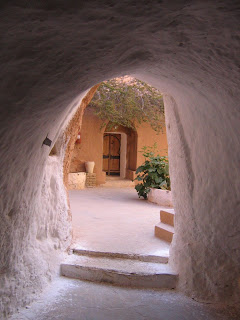
A troglodyte dwelling is essentially a cave. To survive the intense summer temperatures of Southern Tunisia, the Berber learnt to create dwellings under the earth where they were able to stay cool. I'm prone to claustrophobia and was a little freaked out at the idea of sleeping underground, but the troglodytes were really well designed and cozy and I actually enjoyed the experience.

We stayed in the hotel built under this boardwalk in the seaside town of Monastir. Every room looked out over the Mediterranean ocean.

We returned to Monastir on our way back to Tunis and stayed in another hotel where our windows and balcony looked out over the marina.

These were our beds in the Bedouin tent in the oasis of Ksar Guilane in the Sahara. The tent was amazingly well insulated which was a good thing because the temperature at night felt more like the South Pole than the Sahara. I wish I'd taken a picture of the outside.


Ruins
Tunisia is filled with the vestiges of the various civilizations that invaded, colonised and mingled with the indigenous Berber population over 2 mellenia.

The Phoenicians (modern day Lebanese), the Romans, the Ottomans (one area of modern day Turkey), the Byzantines (another area of modern day Turkey), the Arabs, and last of all the French have all left they mark on Tunisia.

As mentioned before the Arabs are responsible for much of the wonderful architecture to be found throughout Tunisia, such as this monument to the first President of independent Tunisia, Habib Bourguiba.

and the French built all the Nouvelle Villes like this one already shown.

Of all the ancient civilisations it is the Romans that have left the most indelible mark on Tunisia. The Northern part of Tunisia is littered with Roman ruins. Just driving along we would stumble upon disembodied columns or arches like this one below.
Here is a sampling of some of the Roman ruins we visited:

The town of Bulla Regia


An arch in the town of Haidra

Coliseum El Gem


The tunnel Gladiators walked through on their way to meet their deaths. Gives new meaning to the saying 'I can see the light at then end of the tunnel'.


Dougga
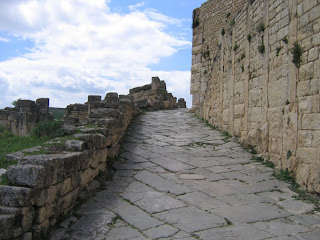
Roman Road in the town of Dougga

Temple


Romans created amazing mosaics to adorn their floors. Many of these can still be seen at the various ruins but most now reside in the Bardo Museum in Tunis which is considered to contain the best Roman mosaics in the world.

Carthage
All that is left of the ancient Phoenician city of Carthage which reached it's height in the 9th century BC before it was invaded and destroyed by Rome which in turn built a new Carthage on it's ruins.


Part of a mosaic which tells the story of Ulysses. Here Ulysses is bound to the mass of his ship so he cannot respond to the call of the sirens.

These two columns to be found in the Great Mosque of Kairouan were recycled from one of the many roman ruins around the country.


Culture/Miscellaneous
Just a collection of random things I found interesting:

One of the most beautiful things I have ever heard in my life was the sound of the Koran being spoken melodically (sounds like singing but technically it is not) from this mosque. We were walking back to our hotel after dinner one night when the Muezzin (the person who issues the call for prayer) began and it stopped us dead in our tracks. It was so incredibly soulful and beautiful that even though I didn't understand the words, I understand the meaning in such an intensely visceral way that it made me weep.


Okay I know how to read it and what it means, but how do I say it?

Cow head or entrails anyone?


Graffiti Art

These dried chili peppers are used to make harissa, a red hot paste which is used as a condiment and/or as an ingredient in Tunisian cuisine.

Look up can offer such wonderful surprises.

Now that's what I call a bus stop.

I could do a whole photo essay on the benches of the world. It is incredible how much variety can be found in such a simple functional public object.

Probably as many donkeys as they are cars in Tunisia.


Now who knew that cork grows on trees? I didn't. Actually, I never though about it until we visited this cork forest. The cork has been removed from most of the bark of this cork oak tree, leaving some cork bark only towards the top. Apparently, a cork oak must be at least 25 years old before its bark can be harvested. Its cork can then be stripped every 8 to 14 years after that for as long as the tree lives.
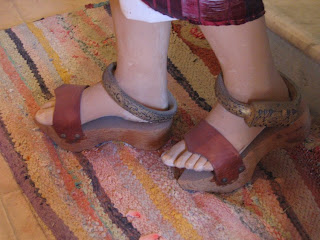
Traditional Berber ankle bracelets and wooden shoes shown on a mannequin. I guess they're designed to keep women from running away.


This guy is wearing a traditional Berber garment called a Jalaba.

Almost every town has some sort of sculpture at it's entrance and exit. I though this one was really lovely.

This was one at the exit of the desert town Douz.

Camels are a much loved motif in Southern Tunisia.

Need I say more?


Tunisia has an amazing system of well kept roads. But the drivers are insane. Here is an example of the kind of craziness that needs to be monitored by someone.


The plaza at night in Houmt Souq.


Craftsman working patiently to embed silver in this carpet comb.

The Great Mosque of Kairouan is the oldest Muslim place of prayer in North Africa and is commonly regarded as the fourth holiest site in IslamafterMecca, Medina and Jerusalem.


This Bedouin instrument sounds a little like a bagpipe. It is made from gazelle skin and various horns.

Public transport taking the Bedouine to the oasis town of Douz 100 kilometers away.


Say what????

Would also be interesting to do a series of photos on the various animals one is warned to look out for on the highways from one country to the next.


So when can we move in?
Tuesday, 13 May 2008

Lately, I haven't felt like blogging. Can't explain why. Every time I thought about writing it just felt like too much effort. It hasn't helped that I have been super busy.

I quickly found out though, that not blogging poses a danger to my staying on track. My food, exercise and water intake have been patchy ... sometimes disastrous and obviously I haven't been happy with that.

On the other hand, I have been feeling quite happy with my life. Last week the sun began to shine in London and the weather turned warm and balmy. London is the kind of city that needs the sun. It transforms the place ... somewhat.

James and I did some spring cleaning and spring planting on Saturday, had a friend over on Sunday and it was so beautiful we were able to have our lunch out on the patio.

This morning I did half and hour on the elliptical trainer and then lifted some free weights. Think I'll begin to post my food again starting tomorrow.

Thanks to you all for your kind words and encouragement. I will press on as must you.

Wednesday, 30 April 2008

Day of Reckoning

Okay, so I've come to the end of my 8 month program and it is time to assess my successes and failures.

Behaviour
I have succeeded to some degree in modifying my eating, water in take and exercising habits and I am grateful for that. I see though that I find it extremely difficult to maintain momentum. This of course is not some great discovery. It's what people struggling with losing weight run aground on all the time.

Results
I am pleased that I have lost weight and cm on my body. I tend to see greater changes in the way my clothes fit than on the scale. I am disappointed though that my inconsistency meant that I spent more time stalled or backtracking than losing.

27th August

30th April

Total Lost

Weight - 90kgs.

Weight - 79.8

10.2 kgs

Bust - 112cm

Bust - 106cm

6 cm

Waist - 95cm

Waist - 86cm

9 cm

Hips - 113cm

Hips - 107cm

6 cm


Photos of my body are always hard for me to look at. Too much reality!!! I don't see much difference between the before and after and that is very disappointing. I mean ... I guess I look a little less like an overstuffed blown up doll ready to bust out of her skin now but only a little. :(

Abnormalities
Yesterday, I saw an adult woman in the supermarket whose thighs were smaller than my arms. How is that POSSIBLE??? I wanted to take a picture of her thighs or just walk up to her and ask if she would mind if I measured the circumference of her thighs just to compare them to my freakishly large arms, but I had neither a camera nor a tape measure and she probably would have had me arrested for harassment or something anyway ... and I wouldn't blame her a bit.


The Present
I've learnt a lot over the pasts 8 months and I hope to apply some of that knowledge over the next 8 months as I try to achieve my goal of losing 24.8 kgs and achieve my goal weight of 55kgs. I am going to continue my focus on eating well, exercising, increasing my water intake and I'm going to add some vitamins supplements like flax meal and a few other things to support my body a little more.

Thanks for all your wonderful comments about the photos. I'll be posting my last batch of photos soon. Takes a long time to condense and edit.

Friday, 25 April 2008

Day 2

Sorry I haven't been able to post over the last few days. Things have been a little hectic.

Anyway, my food has been good and so has my exercise. I walked 4.40miles/7 kilometers yesterday and 6.23miles/10 kilometers today. My water hasn't been as good but I'll make sure I drink enough today.

Well, here are some pictures of Tunisian landscapes, as promised. They are way too many but ....If you want to get a better view of something just click on the photo.

Tunisia has miles of coastline that flanks the Mediterranean sea. These photos are from various points along that coastline.

***
The two largest cities in Tunisia are Tunis (the capital) and the southern town Sfax. There are many mid-sized cities and many many small towns. Every large and mid-sized city is divided into two major areas: an old area called a Medina and a new city called a Nouvelle Ville.

A Medina is a walled city with large doors at each corner or side of the medina. They were built by the Arabs during their colonisation of Northern Africa as far back as the 9th century as protection from attack. The medina contains many narrow and maze like streets, tightly packed houses, palaces, mosques, market places etc. everything found in a city generally.This photo shows the medina wall on the left and homes on the right. The streets within a medina are normally very narrow and the homes very tightly packed.
Souks are shopping areas within the medinas. They are very interesting but very intense experiences as merchants compete so vigorously for one's attention that their behaviour borders on harrassment.

This photo of Sfax is an example of what the nouvelle villes look like. Nouvelle villes were built by the French when they colonised Tunisia in the 19th century.

***

The Northwest of Tunisia is very verdant and green. Reminded me a lot of England with it's soft rolling hills and fertile plains. This area is strongly agricultural.

This large flat topped mountain called Jugurtha's table found in the Central area of Tunisia. It got it's name from a local king who used it as a base during a 7 year battle against the invading Romans around 115 BC. It's sheer impregnable walls make it a natural fortress.
The only way up once you reach the base are by some precarious rough steps hacked into the side of the cliff. These allow you to climb to the top of the table. It was hell getting up them and I can't imagine how a whole village managed to live at the top for years. The hills of Algeria as viewed from the top of Jurgurtha's table.

Ruins of a village built at the top of Jugurtha's table.

***

One of the many mosques on the island of Djerba, located just off the South east coast of Tunisia. Djerba was featured in The Odyseey as the Land of the Lotus Eaters. It's also where the story of Ali Baba and his 40 wives originated.

***

The landscape of southern Tunisia is incredible dry, rocky and generally inhospitable. Considering this, it was amazing to see villages like this one perched on the hillsides.


The village of Chenini was carved into the stone of this mountain.

Door to one of the homes.
View from Chenini. One of the areas where Star Wars was filmed.


Terraced agriculture


Duiret is another town where the buildings are carved into the mountain.


View from the top of Duiret. No matter how poor the village, there's always a pristine white mosque.


***

Palmeries are incredibly wet and fertile areas found in the middle of the arid south. Many herbs, spices, vegetable and fruit trees thrive under the palm trees. Apart from dates which are harvested in August, Palm trees produce a juice called palm juice from April until ... We were fortunate enough to taste it. It's like nectar from the Gods.

Olive trees also grow in great abundance in the south. They seem to be able to grow under the harshest of conditions.

***

These beautiful buildings are called Ksour(plural) Ksar (singular). They were used for storing a village's grain supply.


The Berbers (original inhabitants of Tunisia) discovered that if they built their homes underground, they could stay cool during the periods of intense heat. These homes are called troglodyte homes. Again one of them was used in the filming of Star Wars. I think you can understand why.


***

Yikees!!! A sandstorm. Guess we were bound to experience one of these considering how much wind and sand there was around.

***
Chott is the word for lakes that stay dry through the hot season, but have some water in the winter. Chott el Jerid is largest of these kinds of lakes. Here James is a small speck in the vast river bed. Aparrently, this is another location where Star Wars was shot ... it's supposed to be where Luke contemplated the two moons .. James being a Star Wars fan wanted to re-enact the moment.

***

The Oasis town of Douz is knows as the Door to the Desert. When you leave here your heading for the Sahara.

Dunes reclaiming an ancient fort

On the road to the Oasis Ksar Ghilane

Contrary to popular belief most of the Sahara is not lovely sand dunes. Most of it is flat scrubby driness as below.

but when you get to the dunes, a fabulous reward ...

The sand is as fine as silk and when you try to hold it in your hand, it slips away like water. It even forms pattens like water ripples


This is a desert cafe ...


The Oasis has a great natural hot spring which comes in handy after a long day on a camel.

King of the Desert